English & Language Arts
Reading aloud, comprehension, grammar, spelling and composition. In the lower grades the emphasis is on decoding and fluency; by junior high, pupils write structured essays and answer comprehension papers under time.
Academics
Every pupil at the Academy studies the same core subjects — English, mathematics, science and history — with reading and literature running alongside from the first year to the last.
The core curriculum
The four core subjects are compulsory throughout. Reading and literature, moral formation and physical education run alongside them.
Reading aloud, comprehension, grammar, spelling and composition. In the lower grades the emphasis is on decoding and fluency; by junior high, pupils write structured essays and answer comprehension papers under time.
Number recognition and counting in the ABC and K classes, then the four operations, fractions, decimals, percentages and measurement. From Grade 6, geometry — which is why a geometry set appears on the supply list from that year.
Living and non-living things, the human body, plants and animals, matter, simple energy, weather and health. Practical observation wherever the topic allows it.
The history of Liberia and of Nimba County, West Africa and its neighbours, world geography, civics and the workings of government.
Set texts are bought through the school so every pupil in a class works from the same edition and the same page. Reading is timetabled, not left to chance.
Devotion opens every session. Conduct, honesty, respect for teachers and classmates, and the responsibilities of a citizen are taught explicitly.
Football, athletics and organised play. A genuine break in the middle of a long day, and for many pupils the best part of it.
Singing at devotion and assembly — the part of the school day that everyone can hear from the road.
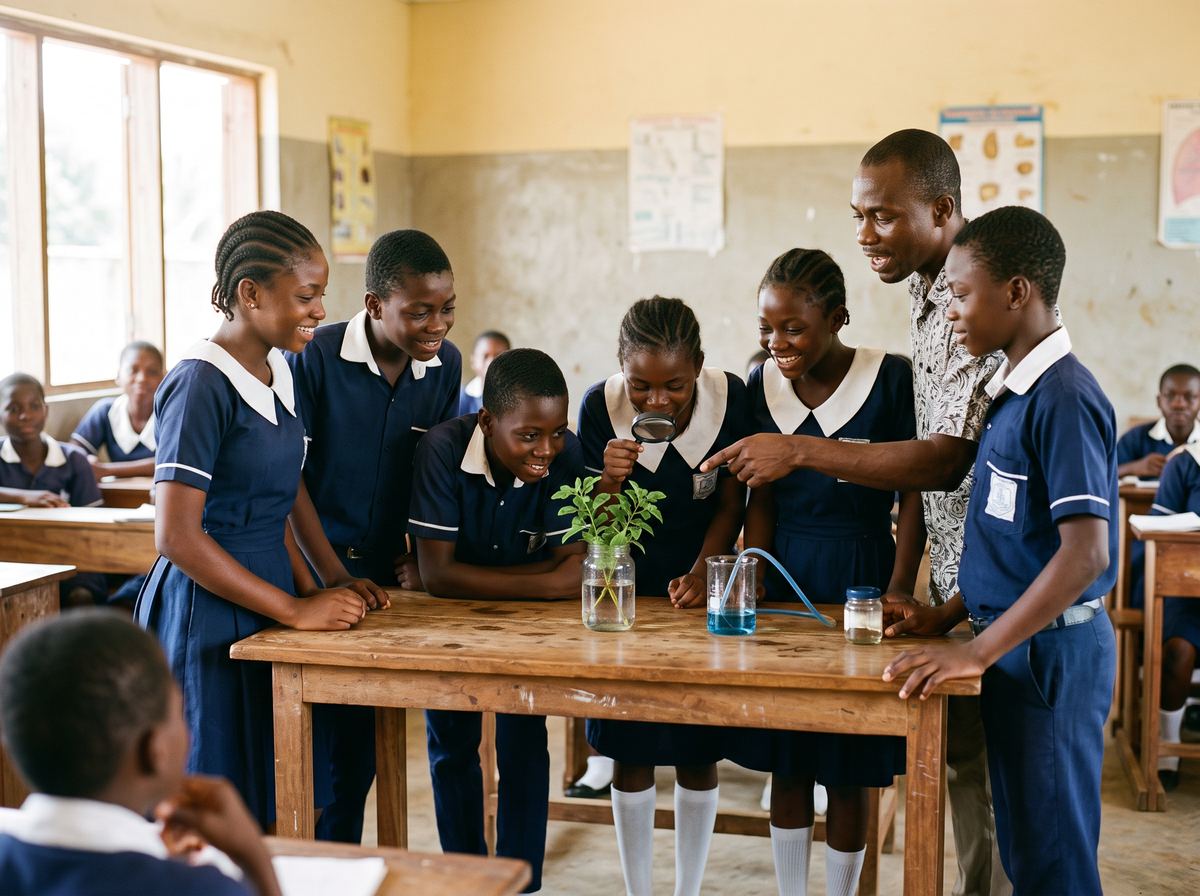
“Science is taught by demonstration — a jar, a plant, a question, and eight pupils leaning in.”
The junior high laboratory table
Two stages, one path
Morning session, 7:00 AM to 1:00 PM. The foundation years. The ABC and K classes concentrate on letters, sounds, numbers and the habits of school. From Grade 1 the full core curriculum begins, and by Grade 6 pupils are working with fractions, geometry and structured written work.
Crayons K2–Grade 3 Pencils to Grade 3 Geometry set from Grade 6
Afternoon session, 1:15 PM to 5:30 PM. Subject teachers take over from the single class teacher. The work becomes examination-shaped: longer written answers, set texts, mathematics with working shown, and science with recorded observation. Grade 9 is an examination year.
Subject teachers Geometry set required WAEC preparation
The school day
Both sessions run Monday – Friday. Please have your child at the campus by the opening time, not the time classes begin — devotion comes first.
| Part of the day | Time |
|---|---|
| Opening Time | 7:00 AM |
| Morning Devotion | 7:30 AM |
| Classes Begin | 8:00 AM |
| Dismissal | 1:00 PM |
| Part of the day | Time |
|---|---|
| Opening Time | 1:15 PM |
| Devotion | 1:20 PM |
| Classes Begin | 1:30 PM |
| Dismissal | 5:30 PM |
Morning devotion begins at 7:30 AM and afternoon devotion at 1:20 PM. Pupils who arrive after devotion has started miss the settling part of the day, and lessons begin thirty minutes later.
The office is open 8:00 AM – 4:30 PM, Monday – Friday. That is when to come for enrollment, fees or a conversation with the administration — the sessions above are class times.
Assessment
Progress is measured continuously, not guessed at the end of the year.
Pupils are assessed through class work, periodic tests and end-of-term examinations. Report cards are issued to parents, and we ask for them back at the next enrollment — they are how we place a transferring pupil in the right grade.
Grade 9 pupils prepare for the West African Examinations Council examinations. WAEC registration fees are separate from tuition and are announced by the office each year.
Daily written work in exercise books, marked and returned.
Short assessments through each term, so difficulty is caught early.
Formal examinations at the end of each term, reported to parents.
The regional examination that opens senior secondary school.
Questions about the programme
English. It is both the language of instruction and a core subject in its own right, from the ABC class through Grade 9.
Yes. Bring the most recent report card or transfer certificate and we will place your child in the grade that matches their actual level. If no paperwork exists, we will assess them ourselves.
Not at all. That is exactly what the ABC class is for. Bring them to the office during opening hours and we will enroll them.
Grades 6 through 9, when formal geometry enters the mathematics syllabus. Crayons or colored pencils are for K2 through Grade 3.
They are purchased through the school. This is deliberate: it guarantees every pupil in a class has the same edition, so a teacher can set the same page for everyone.
Grade 9 pupils sit the West African Examinations Council examinations, which is the qualification senior secondary schools ask for. The office can advise families on the next step.
The supply list, uniform information and admission steps are all on the admissions page.